


The Clinic Call Metrics That Actually Drive Bookings and Revenue
Your clinic phone rings hundreds of times a week. But how many of those calls turn into booked visits? And how many slip through the cracks before anyone picks up?
Most clinic owners and managers track revenue, patient volume, and no-show rates. Fewer track the metrics that happen before a patient ever walks through the door—starting with the phone call that brings them in. That gap costs real money. Research suggests that healthcare practices miss roughly one in four incoming calls, and the vast majority of those callers never try again.
This post breaks down the clinic call metrics that connect your phone system to your bottom line: from call volume and answer rates to booking conversions and capacity. You will walk away knowing exactly what to measure, why it matters, and how to act on what the numbers tell you.
What Are Clinic Call Metrics and Why Should You Track Them?
Clinic call metrics are the quantitative measures that describe how your practice handles incoming phone traffic. They cover everything from how quickly your team picks up to how many callers convert into confirmed appointments.
Tracking these metrics matters for three reasons:
- Revenue visibility. Every missed call has a dollar value. A new patient call to a health and wellness clinic can represent hundreds of dollars in initial visit revenue—plus follow-up care, referrals, and lifetime value.
- Staffing decisions. Call data reveals exactly when your front desk is overwhelmed and when capacity is sitting idle. That turns scheduling from guesswork into a plan.
- Patient experience. Patients judge your clinic by how easy it is to reach you. Long hold times or unanswered calls shape first impressions long before anyone walks in the door.
The Five Clinic Call Metrics That Move the Needle
1. Call Volume and Peak Patterns
Call volume measures the total number of incoming calls your clinic receives per day, week, or month. More importantly, it shows when those calls cluster. Research shows that about 38% of daily calls to medical practices land during the first and last hours of operation—creating predictable rush windows where missed calls spike.
What to do: Map your call volume by hour and day of week. Identify the two or three windows where volume exceeds your team’s capacity. Those are the hours that need reinforcement—whether through additional staff or technology that catches overflow.
2. Answer Rate (and Its Inverse: Missed Call Rate)
Your answer rate is the percentage of incoming calls that reach a live person or an automated system that resolves the caller’s need. The inverse—your missed call rate—is where revenue disappears.
Industry data suggests that healthcare practices miss approximately 23% of incoming calls on average. Solo and small practices often exceed 30%. Studies also indicate that around 85% of callers who reach voicemail will not call back. That means every missed call is very likely a lost patient interaction.
Benchmark to aim for: Below 10% missed call rate during business hours. Below 5% is best-in-class.
3. Call-to-Booking Conversion Rate
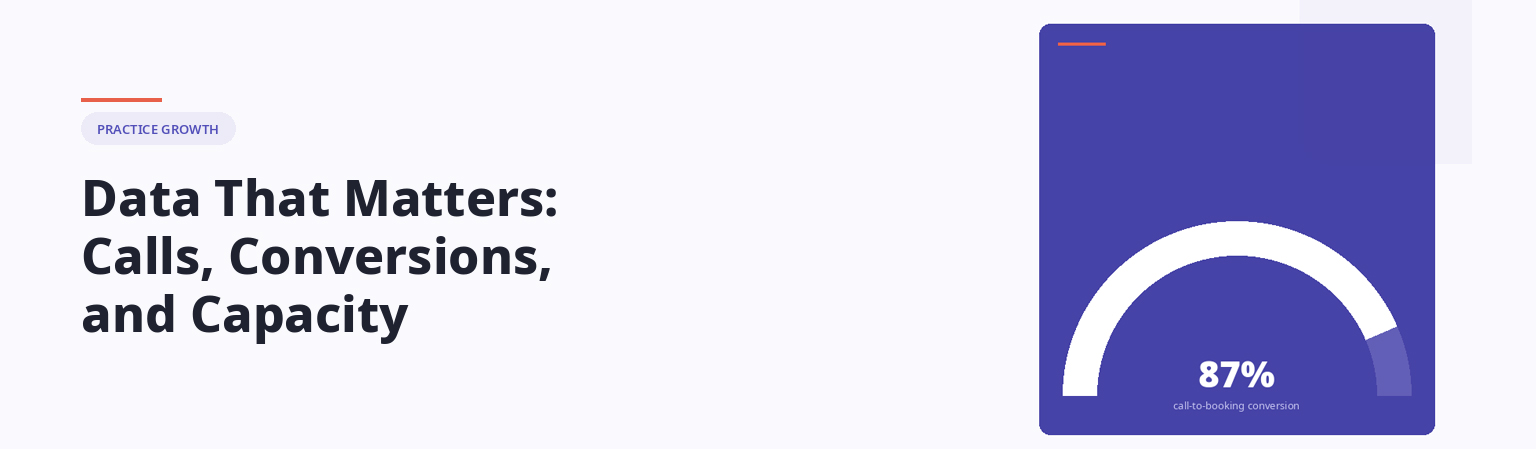
This metric tracks the percentage of answered calls that result in a confirmed appointment. It is the clearest link between your phone and your schedule.
A low conversion rate—even with a strong answer rate—signals friction in the booking process. Common culprits include multi-step transfers, long hold times during scheduling, or callers being told to call back later. When booking happens in one seamless step from the first ring, conversion rates climb.
What to track: Calls answered ÷ Appointments confirmed = Conversion rate. Segment by new patients vs. returning patients for sharper insight.
4. First-Ring Resolution Rate
First-ring resolution measures whether a caller’s need was met on the initial call—without transfers, callbacks, or voicemail. It captures the quality of each phone interaction, not just the speed.
In healthcare, the industry benchmark for first-call resolution sits around 70–75%. Clinics that exceed this tend to have staff with immediate access to schedules, patient context, and booking tools right at the moment of contact.
Why it matters: Every transfer or callback creates another chance for the patient to drop off. Resolving on the first call keeps patients engaged and schedules full.
5. Capacity Utilization: From Calls to Filled Schedules
Capacity utilization connects your call data to your clinical schedule. It answers a simple question: are the calls you handle actually filling the appointment slots your clinicians have available?
Track the ratio of booked appointments from calls against available appointment slots for the same period. A gap between the two signals that either demand is not reaching your schedule (missed calls, poor conversion) or supply is mismatched to demand (wrong hours, wrong provider availability).
Actionable insight: When capacity sits below 85%, dig into your call data before adding more slots. The bottleneck is often the phone, not the schedule.
Common Mistakes Clinics Make When Measuring Call Performance
Even clinics that track call data often fall into traps that reduce the value of what they measure.
- Tracking volume without outcomes. Knowing you received 200 calls last week means nothing if you do not know how many became bookings. Always pair volume with conversion.
- Ignoring after-hours data. Research on patient call patterns found that roughly 11% of patient calls happen outside standard office hours. If your tracking stops at 5 p.m., you are missing a meaningful slice of demand.
- Averaging across the whole day. A clinic that answers 90% of calls overall but misses 40% during the 8–10 a.m. rush is leaking revenue at the worst possible time. Segment by time window, not just daily averages.
- No connection to revenue. Call metrics without financial context are interesting but not actionable. Tie missed calls to estimated lost revenue—even a rough calculation creates urgency.
How to Turn Call Data Into Better Decisions
Data without action is just noise. Here is a practical framework for turning clinic call metrics into operational improvements.
- Build your baseline. Measure your current answer rate, missed call rate, and call-to-booking conversion for at least two weeks. Segment by hour, day, and call type (new vs. returning).
- Identify your biggest leak. Is it missed calls during peak hours? Low conversion despite good answer rates? After-hours demand with zero coverage? Focus on the single metric with the largest gap between current state and benchmark.
- Match the fix to the problem. If peak-hour misses are the issue, consider overflow support or AI-assisted call handling. If conversion is the gap, look at how quickly your team can access the schedule during a call. If after-hours demand is significant, explore automated booking that works around the clock.
- Set a 30-day target and review. Pick one metric, set a realistic improvement target (e.g., reduce missed calls from 25% to 15%), measure weekly, and adjust. Small, focused improvements compound over a quarter.
What a Connected Phone System Changes
Most clinics run their phone system as a standalone tool—separate from their EMR, separate from their schedule, separate from their reporting. That separation is where data gets lost.
When your phone system is integrated with your clinic management platform, every call automatically carries context: who the patient is, their upcoming appointments, their last visit, and what they likely need. Front-desk staff and AI call handling alike can resolve calls faster because the information is already there.
Clinicmaster’s integrated VOIP and AI Receptionist are designed for exactly this. Calls, bookings, and patient data live in one system—so your team sees real-time dashboards that connect phone metrics to schedule fill rates and revenue. No manual exports. No data reconciliation between platforms.
The result: you stop guessing about what happened on the phone and start seeing how every call connects to a booked appointment, a filled schedule, and a healthier bottom line.
Your Phone Is a Revenue Engine—Treat It Like One
The metrics that matter most in your clinic are not buried in complex analytics dashboards. They are straightforward: How many calls are you catching? How many become bookings? And is your schedule as full as your demand says it should be?
Start by measuring your answer rate and call-to-booking conversion this week. Those two numbers alone will tell you whether your phone system is helping your clinic grow—or quietly holding it back.
Your team works hard to deliver great care. Make sure the phone works just as hard to bring patients through the door.
See how your calls connect to your schedule—in real time
Clinicmaster’s VOIP and AI Receptionist give you one dashboard for calls, bookings, and capacity. Book a free 20-minute demo at clinicmaster.com and see how clinics like yours turn phone data into full schedules.
Questions clinical
and IT leaders ask us.
Call-to-booking conversion rate is the single most actionable metric. It measures how many answered calls become confirmed appointments. A high answer rate means nothing if callers are not converting to visits. Track this weekly, segmented by new and returning patients.
Industry data suggests that healthcare practices miss approximately 23% of incoming calls, with smaller practices often exceeding 30%. During peak hours like 8–10 a.m., miss rates can climb even higher. Most callers who reach voicemail will not try again.
Multiply your estimated missed calls per month by your average new-patient visit value. For a rough annual figure, multiply that by 12 and then by 0.85 (the estimated share of callers who will not call back). Even conservative estimates often reveal six-figure annual revenue gaps.
A missed call rate below 10% during business hours is a strong target. Best-in-class clinics aim for below 5%. After-hours coverage—via staff or AI—can close the gap further, especially since roughly 11% of patient calls happen outside standard hours.
When your phone system connects to your EMR and scheduling platform, staff see patient context instantly during calls. That means faster resolution, fewer transfers, and higher first-call booking rates. Integrated systems like Clinicmaster VOIP also generate real-time dashboards that tie call performance directly to schedule fill and revenue.
Yes. AI call handling is designed to manage overflow and after-hours volume—routine tasks like appointment booking, confirmations, and FAQ responses. Human staff handle complex or sensitive calls. The goal is relief for your team, not replacement. Clinicmaster’s AI Receptionist works alongside front-desk staff in exactly this way.